Companies that excel at sales growth are tightly focused on developing the talent they need by understanding how sales reps really work.
With as much as half of a company’s value creation resting with the sales force, sales-team effectiveness is crucial for growth. In fact, our research shows that the sales experience is one of the top drivers in customers’ purchasing decisions. And best practice has revealed that companies focus as much on the rep experience as on the customer experience.
Realizing that value, however, has become a lot harder. The sales landscape is more unpredictable and studded with multiple influencers, channels and buying options. Digitization is changing buyer behaviors and leading to more complex sales activities. Guiding decision makers through all the nuances and considerations requires sellers to demonstrate deep subject-matter expertise and the ability to quickly customize a message to each customer.
These challenges call for a new set of sales skills, training, and tools. Companies are having trouble filling that void, however, because many of them lack the means to identify and cultivate the skills they need. Performance can vary by as much as six to seven times between top- and bottom-tier sellers, yet few organizations have metrics that show why. As a result, hiring choices are often based on gut feelings, while development and training often default to methods that have been in place for years.
To better understand how the best sales leaders manage talent, we developed a “sales DNA” tool. It tracks and analyzes the talent-management practices of more than 100 sales organizations as well as the traits and attributes of over 15,000 sales representatives across a range of transactional, consultative, and other sales environments globally.The results reveal that organizations with the fastest growth know who their top performers are—surprisingly, many businesses don’t—and know the personality traits and skills that correspond with success. They’re also far more likely to customize outreach, tools, and techniques to the needs of different teams. In fact, as we analyzed fast-growing organizations, it became clear to us that top-performing sales organizations treat their salespeople like customers.
To realize the full value potential of digital, successful sales organizations reorganize top to bottom, front end to back end. Here’s their road map.
“We’ve got to go digital.” Every sales leader has heard some variation of that statement. But what is digital, actually? And of all the digital things to do out there, what matters most for driving sales growth?
To help answer this question, we conducted a survey of more than 1,000 US and European sales executives, as well as interviewing dozens of sales executives and doing research for the book Sales Growth: Five Proven Strategies from the World’s Sales Leaders. In our first article from this data set, we looked at the five areas where sales leaders outperform their peers (see “The sales secrets of high-growth companies”).
For this article, we looked at the how organizationally sales leaders drive performance. Our analysis revealed that fast-growing companies1successfully connect seemingly opposite approaches:
Front to back: Create a dynamic experience for customers, and use digital tools and data to power operations. It’s common for companies to overemphasize one or the other, but the greatest success lies in a marriage of both.
Top to bottom: Successful sales organizations also overhaul the way things are done, from sales leadership all the way through front line sales reps.
While this structure might sound like a “do everything” approach, its value is in providing a simple way to think through the connections needed throughout the organization to get the most from digital capabilities, from automating processes to delivering experiences across all channels to using analytics to enable the sales force.
Of course, this is all much easier said than done. In our survey, a majority of sales executives said that their companies are increasing their investments in digital sales tools and capabilities for the near term. Yet less than 40 percent believe they are even moderately effective at it and a mere 17 percent rate their capabilities as “outstanding.”
At last, after almost 12 years of careful research, the Quantum Sales Management System was finally launched on July 20 2016.
The delay was regrettable as much study had to be given due to the dynamic changes in sales management today as well as the willingness of the sales personnel in embracing such system as part of their work culture. Next, a partner had to be sought, one who has the aptitude to collaborate on such a project especially in the field of programming, to program the system, and on this we welcome Infotree Sdn Bhd (a member of the Ikram Group) to the team.
How does the system work? Basically, it operates on four simple forms, i.e. the Weekly Planner, the Daily Sales Report, the Prospect Information Sheet and Call Objective Form. However, these four forms are so well integrated into the system that they are hardly seen at all but the Sales Personnel will be using them, nonetheless.
The system has two sections :
Section 1 : For use by the Sales Leader, whereby he will set the tone and direction for the sales team -
1.1 The number of calls per day
1.2 Determine the call ratio for a certain period, e.g. New Account:Follow up Calls. Depending on the sales situation of a period where sales are not doing well, the Sales Leader might want to set the Call Ratio at 80:20 percent, i.e. 80% on New Account and 20% on Follow-up Account. However, in Key Account Management, the ratio may be reversed, e.g. 20:80, i.e. 20% New Account and 80% Follow-up Account. Once the ratio is set, the Sales Personnel will then begin to plot their sales calls as such. Any deviation will prompt the system to alert the user that he is not within the parameter of the required calls.
1.3 The system also allow the Sales Leader to dictate the number of visits per client for the staff. This is to time manage the staff so that they will not waste productive time on unproductive prospects.
1.4 The Call Objective section is for the Sales Leader to highlight to the Sales Personnel the kind of products that needed to be sold in the market. This will help in moving slow stock which in return help in inventory management. The other objective is to ensure the Sales Personnel to cross sell company products.
Section 2 : For use by the Sales Personnel to plot their calls for the coming week. Every item decided by the Sales Leader will be reflected in this section which must be abided by the Sales Personnel. It will start with the Weekly Planner and then their Daily Sales Report. Any deviation will be picked up by the system and staff will be alerted.
Benefits:
1. In the past, as well as present, hard copies are being used in sales planning and reporting. This will now be a thing of the past especially in this age of technology. Companies can now go paperless.
2. Sales Personnel can now do their reporting wherever they may be, even in a mamak shop or kopitiam.
3. Senior management staff, e.g. CEO, ED and/or GM can now view the staff activities and give timely decision to assist them in closing the sale. However, the senior staff are not allowed to make comments other than the Sales Leader. They can only view the plan and report, and they do not need to wait for the staff to complete their written report (which might take days) in the office to have it then called for review.
4. Sales Leader can now use the report to execute public relations exercises with new prospects.
5. Sales targets henceforth can be seen as achievable.
6. Staff confidence level will be boosted as they now have a sense of direction in pursuing their sales objectives.
System Effectiveness
This is a tried and fully tested system used in a club, bank and trading house environment where the writer used to manage. It can also be applied in other kind of businesses.
Suitable for :
Securing new acccount
Key Account Management; and
Managing The Dealers
Current Users :
1. QP Industries Sdn Bhd
2. Protasco Trading Sdn Bhd
Billy Ong (seated second from left) with the technical support team. On his right is Business Associate, Regina Ng.
The above is just a gist of what the system can do. For a free demo, without any obligation, you may contact the following :
Billy Ong Handphone no: 012-688 4989 Regina Ng Handphone no: 016-288 3091
Or Email us at: quantumsms16@gmail.com
"POOR SALES RESULTS REFLECT POOR STANDARDS"
In the final leg of the preparation before the launch, the blogger (designer) and the programmers sitting down for one last check.
What distinguishes sales organizations
at fast-growing companies from their lagging peers? In a wide-ranging
survey of more than 1,000 companies, we unearthed five meaningful
differences:
1. Commitment to the future
That the world is changing ever more quickly may be a cliché, but
that makes it no less true: all sales leaders know that they need to
anticipate changes that could turn into opportunities or threats. Yet
the best leaders move beyond acknowledgement to commitment.
They make trend analysis a formal part of the sales process through
systematic investments of time, money, and people. Building and
sustaining the capability to take a forward-looking view of the market
is not easy. In discussions with more than 200 sales leaders while
researching our new book, Sales Growth, two common characteristics emerged: the mind-set of sales leadership and resource commitment.
Sales leaders must consistently monitor the macro-environment in
search of sales opportunities, no easy task given the relentless
pressure to hit near-term targets. Forward planning must be part of
someone’s job description—not just part of top management’s lengthy
to-do list—with sufficient resources to take advantage of the best
opportunities. Companies have to be willing to take risks now to create
sales capacity long before the revenue will materialize. More than half
of the fast-growing companies1
we analyzed look at least one year out, and 10 percent look more than three years out.
After planning, sales leaders aren’t afraid to put their money where
they think the growth will be: 45 percent of fast-growing companies
invest more than 6 percent of their sales budget on activities
supporting goals that are at least a year out—a significant commitment
in an environment where sales leaders fight for each dollar of
investment.
As the world evolves at a rapid rate today, people must embrace change. Not to do so is futile for the world will just pass you by and before you knew it, you will be left far behind.
Esther Derby is quite right when she says people don’t resist change, they resist coercion. From our experience, when people understand the compelling reason why for change, feel actively involved, share the vision and are guided by trusted, inspirational leadership then change becomes “effortless”. Change happens one person at a time and by nurturing change amazing results happen.
People who are in the sales profession, hardly had the time to think about change due to their hectic schedule. Everything they do has become a 'habit'. But change must happen or otherwise one day they will be wondering why customers are no longer buying from them. Sales leaders must drive the change with innovative ideas in order to stay relevant in the market place.
You do not need books or psycho babble to work out how to motivate
people. Start by thinking about the best boss you have ever worked for.
What did the boss do to motivate you so well? Do you do the same things
with your team?
In practice, most of us respond to some simple motivational measures. Here are my top ten:
Show you care for each member of the team, and for their career.
Invest time to understand their hopes, their fears and dreams. Casual
time by the coffee machine, not a formal meeting in an office, is the
best way to get to know your team members. Create training plans for
each of your team members, 99% of your team want to do a better job
Say thank you. We all crave recognition: we want to know that we are
doing something worthwhile and we are doing it well. Make your praise
real, for real achievement. And make it specific. Avoid the synthetic
one minute manager praise (”gee, you typed that email really well…”).
Put it in writing really works ( and a copy to your boss would be the
icing!
Never demean a team member. If you have any criticism, keep it
private and make it constructive. Don’t scold your team members like
school children: treat them as partners and work together to find a way
forward. Discuss the issue, not the person and stick to facts. Praise in
public, reprimand in private is the rule.
Delegate well: delegate meaningful work, which will stretch and
develop your team member. Yes, there is routine rubbish to be delegated,
but delegate some of the interesting stuff as well. Be clear and
consistent about your expectations.
Have a clear vision. Show where your team is going and how each team
member can help you all get there. Have a clear vision for each team
member: know where they are going and how they can develop their
careers.
Trust your team. Do not micro manage them. Coach them in what needs
doing - not how to do it. Have courage to implement MBWA: Management By
Walking Away.
Be honest. That means having difficult, but constructive,
conversations with struggling team members. Your job is to set standards
and help struggles achieve them. Don’t hide or shade the truth. Honesty
builds trust and respect.
Set clear expectations. Be very clear about promotion prospects,
bonuses and the required outcome of each piece of work. Assume you will
be misunderstood: people hear what they want to hear. So make it simple
and repeat it often and be consistent.
Overcommunicate. You have two ears and one mouth: use them in that
proportion. Listen twice as much as you speak. Set up regular 1 2 1
meetings with each of your team, so that you can listen to them. Then
you will find out what is really going, what drives your team members
and you can act accordingly.
Don’t try to be friends. It is more important to be respected than
liked: trust endures where popularity is fickle and leads to weak
compromises. If your team trusts and respects you, they will want to
work for you.
As with all things that sound simple, in practice it is very hard to
do all of this consistently well. It is high effort, but normally very
high reward. A motivated team will climb mountains which unmotivated
teams do not even look at.
What motivates your team?
So what do you think of our ways of motivating the team? What do
you do to effectively ensure your team are a success? Please share your
thoughts in the comments section as we learn just as much from
you as you do from us.
Every salesperson knows the quality of their sales manager will have a profound impact on their own success. A recent study I conducted proves this point. Sixty-nine percent of salespeople who exceeded their annual quota rated their sales manager as being excellent or above average. In addition, the quality of the sales organization is directly associated to the quality of sales leadership. Fifty-six percent of salespeople who rated their sales organization as excellent also rated their sales manager as excellent—compared to only 3% who rated their organization as average.
If the best sales organizations have great sales leaders, what separates high-performing sales leaders who exceed their quota from underperformers who miss their quota by more than 25%?
To find the answer to this question, over 400 sales leaders (vice presidents of sales and frontline sales managers) completed an extensive sales management performance study. Twenty-nine percent of participants met or exceeded their annual quota last year, while 42% achieved between three quarters and all of their quota. Twenty-nine percent achieved less than 75% of their annual quota.
I also interviewed over 1,000 sales leaders to better understand the impact of management styles and personality patterns on sales success. This combination of quantitative and qualitative research provides insights about the attributes of high-performing sales leaders compared to their less successful counterparts. These attributes are described below in order of priority.
Target fixation. The best sales leaders are target and deadline driven. In personality testing, top sales managers scored 19% higher in the self-discipline facet, 20% higher in the success-driven facet, and 27% higher in the priority-focused facet than underperforming sales managers. As a result, they have the natural disposition to fixate their team on achieving their revenue goals at the exclusion of all else. They block out distractions and compartmentalize negative news that might sidetrack their team or cause their department to flounder. They keep their team focused and moving forward with a sense of urgency, regardless of the circumstances.
Command instinct. Great sales leaders establish firm command over their team by exercising the power their title and position entail. For example, they hold their team to a higher level of accountability. Seventy-five percent of high-performing sales managers agreed that their salespeople are consistently measured and held accountable against their quota, compared to 58% of underperforming sales managers. However, their authority is not autocratically administered as you might think. Rather, it is based upon establishing an environment where sales team members continually seek to prove themselves, thereby driving higher overall departmental performance. The leaders establish this culture using a “carrot and stick” psychological approach. Overachievers receive praise and public recognition, while underachievers are admonished or ostracized until they redeem themselves. In essence, the command instinct is responsible for creating the peer-pressure and attention-seeking environment that eliminates complacency.
Hiring ability. The ability to hire quality talent will determine the success or failure of the sales organization. Seventy-two percent of high performing sales managers rated the sales team they manage as excellent or above average, compared to 54% for underperforming sales managers. Conversely, 46% of underperforming sales managers rated their team as average or below average, while only 28% of high performing sales managers thought so. High-performing sales managers focus on hiring salespeople who are skillful builders of relationships, are persuasive, and have a reservoir of experience they use to control sales cycles.
Sales intuition. Sales is a mentorship-based profession, and a key differentiator of great sales leaders is their ability to dispense tactical sales advice and add value during customer meetings. While the average sales experience for both high-performing and underperforming sales managers was 17 years, high-performing sales managers estimated they have achieved their annual quota 88% of the time over the course of their career. Underperforming sales managers indicated they have achieved their quota 75% of the time. This suggests that the depth of a manager’s sales intuition—the practical knowledge gained from the experiences of participating in sales cycles and managing salespeople—is directly associated with their success.
Control orientation. Sales managers who closely monitor and strictly enforce a sales process are more likely to exceed their quotas, and the best sales leaders seek to control the daily behavior of their sales teams. Forty-three percent of high-performing sales managers responded that their sales process was closely monitored, strictly enforced, or automated, compared to 29% of underperforming sales managers. Forty-four percent of underperforming sales managers indicated they had a nonexistent or an informal structured sales process.
Coaching adaptability. Great sales leaders understand that there is a diversity of selling styles by which salespeople can achieve success. Therefore, they don’t employ a one-size-fits-all coaching style. Rather, they adapt their style to suit each individual. The fact that high-performing sales managers had a higher team effectiveness factor than underperforming teams supports these statements.
A team effectiveness factor is calculated by averaging total quota achievement across the number of salespeople on the team. For example, if a team of ten sales reps who each had $1 million quotas sold $8 million in total revenues, the team effectiveness factor would be 80% ($8 million of actual sales divided by $10 million of quota). High performing sales managers averaged an 81% team effectiveness factor, while underperforming sales managers averaged 55%. One explanation for this significant difference is that high-performing sales managers have a wider range of coaching adaptability.
It’s also important to note that high-performing sales managers had higher quota risk pool factors than underperforming sales managers. A sales manager’s quota risk pool factor is calculated by adding together all the quotas of the salespeople who report to the manager and dividing the sum by the manager’s quota. For example, a sales manager with a $10 million quota who manages ten salespeople with $2 million quotas would have a quota risk pool factor of two.
Strategic leadership. All sales leaders are battlefield commanders who must devise the organization’s sales strategy to defeat the competition. This requires plotting the best course of action to maximize revenue using the most cost-effective sales model. Great sales leaders possess the knowledge to correctly deploy field or inside salespeople, to segment the market into verticals, and to specialize sales teams by product or customer types when necessary. This helps explain why there was a 51% quota performance gap between high-performing and underperforming sales leaders last year. High-performing sales leaders reported an overall average annual quota attainment of 105% compared to 54% for underperforming sales managers.
The sales organization is unique and unlike any other department of a company. The best sales organizations have strong leaders who exercise control and establish the code of behavior that all team members must abide by. They employ their experiences to determine strategic direction and coach team members individually. Most importantly, they know how to keep the team on track and focused on winning.
It is important that as a sales manager, it takes a little more effort to be accessible to the entire team. But doing so is vital – it builds trust, helps people do their best work and gives you latitude when you have to ask for hard things or make tough choices. These are a few things I do to stay connected to the team that deliver big impact for minimal time and effort.
1. Call everyone in the company by name
Learn names and use them. With a large team, this may take homework, like using LinkedIn to help match faces with names.
2. Say "hi" first
When walking by a team member, always say hi to them before they say hi to you. Make eye contact, and, of course, use their name!
3. Make time to connect one-on-one
When I was managing sales teams of my own, at least twice a week, I meet for coffee or tea with different members of the sales team to learn about what they’re working on, hear their (often genius!) ideas about their jobs and the company, to learn what I can be doing better, and to get to know them. I really enjoy these chats, both personally and professionally.
4. Respond to emails quickly
Even if you can't read through something right away, acknowledge that you got it and that you'll look at it later. Having been on the other side of it, I know it can be nerve-racking or frustrating when it takes your boss a long time to respond to an email. Our Customer Support team operates by this philosophy of respect, too, and answers customer emails in under 9 minutes!
5. Connect on social media
When someone new starts, try to make sure to add them on LinkedIn and follow them on Twitter.
6. Be in the moment during meetings and chats
No iPhone in meetings or one-on-ones! If you do have to check your phone, explain the context and draw the person/people you’re meeting with into the situation with details about what’s going on and why it is time sensitive – and ideally say this ahead of the meeting.
7. Create the company you would have wanted to work at
If your company’s not that fun, make it fun, whether that’s an in-office bar (my personal bias), spontaneous outings or something else you deem cool. I also always thought it was odd to make people pay for coffee (which helps them do their jobs better!) so we offer this for free.
8. Meet everyone on their first day on the job
As long as I’m in town, I meet every new sales team member right when they start. I’m just as excited to have new faces in the office as they are to be joining the team!
9. Be on time
Being late sends a message that you think your time is more valuable than that of the person you’re holding up. I try to show up to meetings a minute early, and make every effort to do calls exactly on time.
Would love to hear the small but impactful changes you’ve made to increase connection and accessibility as a boss – or as a colleague!
As a Marketing or Sales Manager, or even a CEO of a company, we are involved in decision-making day in and day out, whether we like it or not. Sometimes decisions made are a cinch but there are times when the decisions made could have a positive or negative impact on the outcome. A good leader must have the courage to decide what is best for the company. Below is an example of one issue that involves a life or death situation. How would you decide?
Insight into Decision Making - Good One:
A group of children were playing near two railway tracks, one still in use while the other disused. Only one child played on the disused track, the rest on the operational track.
The train is coming, and you are just beside the track interchange. You can make the train change its course to the disused track and save most of the kids.
However, that would also mean the lone child playing by the disused track would be sacrificed. Or would you rather let the train go its way?
Let's take a pause to think what kind of decision we could make........ ........ Pick the track first.
Then Scroll down ....
v
v
v
v
v
v
v
v v v Most people might choose to divert the course of the train, and sacrifice only one child.
You might think the same way, I guess.
Exactly, to save most of the children at the expense of only one child was rational decision most people would make, morally and emotionally.
But, have you ever thought that the child choosing to play on the disused track had in fact made the right decision to play at a safe place?
Nevertheless, he had to be sacrificed because of his ignorant friends who chose to play where the danger was.
This kind of dilemma happens around us everyday.
In the office, community, in politics and especially in a democratic society, the minority is often sacrificed for the interest of the majority, no matter how foolish or ignorant the majority are, and how farsighted and knowledgeable the minority are. The child who chose not to play with the rest on the operational track was sidelined.
And in the case he was sacrificed, no one would shed a tear for him. The great critic Leo Velski Julian who told the story said he would not try to change the course of the train because he believed that the kids playing on the operational track should have known very well that track was still in use, and that they should have run away if they heard the train's sirens.
If the train was diverted, that lone child would definitely die because he never thought the train could come over to that track! Moreover, that track was not in use probably because it was not safe.
If the train was diverted to the track, we could put the lives of all passengers on board at stake!
And in your attempt to save a few kids by sacrificing one child, you might end up sacrificing hundreds of people to save these few kids.
While we are all aware that life is full of tough decisions that need to be made, we may not realize that hasty decisions may not always be the right one.
'Remember that what's right isn't always popular... and what's popular isn't always right.'
Everybody makes mistakes; that's why they put erasers on pencils.
I have been managing staff of all levels for 35 years and there had never been a day that went by without a conflict being posed to me. When such things happened, there are two ways of tackling the issue. One, take the bull by the horn, or two, avoid it and hopefully by next day, it would have gone away. In the early days of my managing people, I always had the fear of being seen to be taking either side once a decision is made, but as one grew with experience and matured on the job, such fear became less and less intimidating.
In today's posting let me share with you two simple ways to resolve conflicts.
Managers spend a considerable amount of their time resolving conflict and other nonproductive behavior, and that’s unlikely to change. But there are two ways to reduce it.
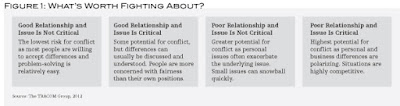
1. Anticipate and plan for conflicts. Anticipating conflict is not looking for a fight. It’s understanding that certain situations are more likely to result in conflict. These might include delivering bad news, competing priorities, deadline stress, previous negative experiences or conflicts, and personality and behavioral style differences.
It might seem that work conflicts are about work, but also consider existing relationships and the perceived importance of the work outcome to help identify and head off potential conflicts (Figure 1).
Leaders who have assessed the potential for conflict can take steps to minimize it. They must understand their behavioral preferences and those of the other person. What is important to each party? How do they like to use time — move quickly to business issues or socialize? What information is important to them — facts and detailed projections or personal stories and input from others? How do they make decisions — quick decisions leading to quick action or thoughtful consideration before acting?
Behavioral preferences can derail a situation even without any fundamental business issues. Understanding others’ preferences and taking steps to accommodate them increases comfort, reduces tension and increases employees’ willingness to work productively with others.
2. Handle conflicts as they occur. Sometimes even the best planning can’t prevent a conflict. But advance prep work will help keep discussions professional and focused on the business at hand rather than personal or behavioral issues. Follow these steps when working with others:
• Pay attention to signs of tension. Everyone shows signs of stress, and identifying these clues can head off and reduce the impact of conflict. Not everyone’s tension shows itself in the same way. Some people will show their discomfort by becoming more animated and taking control; others will become quiet and withdrawn. While the clues may be different, they will be noticeable. Watch and listen for when a person’s behavior changes from his or her norm.
• When a person’s tension is rising, think about his or her preferences, such as using time or making decisions. Refocus the discussion toward his or her preferences to lower tension. Try to get all concerns on the table, and then validate the concerns people have shared.
• Move toward mutual agreement. For some people, making a decision is itself considered an accomplishment. For others, moving too quickly creates more tension. With practice, leaders become adept at understanding when — and with whom — to move things to closure. In some situations, ending the interaction without further damage can be considered a win.
As December approaches, many companies will be carrying out their appraisal or evaluation exercises on their staff. Some of the interesting things that I have observed when I was the appraisee, there seemed to be a lack of preparation on the part of my superior, or amazingly, they were not even sure how to appraise me as a sales person or a marketing person. There was even a lack of understanding of the standards set for me which was, shockingly, disputed during the exercise. That left me, needless to say, in a very awkward position. Now, as a consultant, I would like to share some simple guidelines with fellow managers so that the staff will be adequately rewarded (or not rewarded) for the contributions they made during the year.
The guideline :
An appraisal exercise is a remedial exercise for the staff, and if it is found that there are shortcomings on the part of the staff in terms of skills, both parties must agree to a remedial plan [or development plan] to correct or enhance the skill, and that is via a series of training programmes. The following prescribed form must be signed by both parties, the appraisor and the appraisee, and to later submit to the training department for the scheduling of training programmes for next year.
According to a possibly apocryphal story, the head of sales of a multinational apparel company dispatched two salespeople to open a new territory in a predominantly rural country. After scouting a few villages, the first salesman rang the head office. “I’m returning on the next flight,” he said. “We can’t sell shoes here. Everybody goes barefoot.” Meanwhile, the second salesman was busy e-mailing the head of sales: “The prospects are unlimited. Nobody wears shoes here!”
Emerging markets can be fertile ground for enormous sales growth but each market has its own unique hurdles. Without a deep understanding of the local customer you are likely to trip over those obstacles—or abandon the market prematurely like our apocryphal salesman above. To break into emerging markets and capture the potential, the best sales leaders have realized they have to think like a local.
Emerging-market infrastructure is often less developed, channels are fragmented, and cultural preferences often more complex and varied.
Multinational corporations often make the mistake of importing approaches that work at home without making any adjustments. Meanwhile, local players often underestimate both the resources and speed required to match market needs and compete with global players.
To accelerate growth in emerging markets, leading sellers understand three imperatives:
Get on the ground. Information on customers and the market is often hard to obtain. Successful companies invest in all the data sources and expert information available, but nothing beats getting a firsthand sense of how the market works by visiting local areas and resellers. This ground-level view also gives sales leaders a clear read of where the market is heading and lets them plan for it.
2. Overinvest in the right partners.
In developed markets, a company may have many capable potential partners. In emerging markets, finding a partner is a much more strategic endeavor. With limited choice, partnerships are for the long haul, which means finding the right capabilities and partners that share your values.
3. Build talent for the long term.
Annual growth in emerging markets can exceed 10 percent. That pace requires sales leaders to think creatively about how they will attract and retain the talent they will need to keep up.
Get on the ground
Emerging-market infrastructure is often less developed, channels are fragmented, and cultural preferences often more complex and varied. Demand can be unpredictable, making the near-term return on sales investment uncertain, even if the long-term growth is extremely attractive.
Complicating these challenges is a lack of data. Multinationals that enter developing markets often have to do their own research to develop insights—mixing whatever local market data they can buy, in-field experience, and on-the-ground research. This can’t be done back at headquarters.
A global resources company watched sales volumes rise dramatically across Asia on the back of surging economic growth, but was alarmed by its dependence on a single economy. The board demanded a granular perspective based on the microdrivers in the local market and combined locally available statistics with expert interviews and field observations. This allowed sales leaders to model product demand and adjust sales strategies. Ultimately, the analysis supported expansion and helped the business maintain market leadership. Over the subsequent 12 months, the forecasts proved accurate to within 5 percent of actual demand.
There is no substitute for intelligence gained firsthand on the ground. When a wireless-communications provider that was expanding in Africa prepared to launch new mobile-payment services, it assumed it should focus on countries with the highest GDP per capita. However, the company’s senior management team knew that official data would not provide a truly reliable picture of where actual purchasing power resided. So the team spent most of its time in the field to understand the dynamics in several priority markets.
The deeper it dug the less confident it became about its initial assumptions. In one West African country, for example, the company discovered that consumers in larger towns placed a premium on cell-phone use over other discretionary spending categories because they used those phones to stay in touch with friends and family members who had remained behind when they left home to look for work. This suggested that significant consumer spending power existed outside major cities.
The company also discovered that most people supplemented their salaries by bartering goods and services for items they could not afford to buy with cash. The team therefore probed the barter value of prepaid cell-phone minutes. Next came a game-changing insight. The researchers found a strong cultural bias toward cash: people would camp out near ATMs to withdraw their entire paychecks the moment they cleared at midnight. The company postponed launching mobile payments and focused instead on expanding its core wireless services to smaller cities. Other African countries had different dynamics, and the company tailored its strategies accordingly, helping it become one of the largest providers in the region.
In India, product sales involve layers of distributors and resellers, and channel recommendations play a critical role in driving purchasing decisions. This final point of sale is often a local mom-and-pop shop with a very limited inventory covering a range of products and brands. A domestic cement company realized that it was effectively blind to what was happening at this final, critical step so it handed out simple GPS devices to field reps so that they could log individual points of sale for all cement products in the market. Over six months, a database of more than 22,000 outlets came together. Analysts then matched this information with local census data on evolving population and spending patterns to identify areas of growth with low penetration. The fieldwork also provided an initial assessment of which resellers would be their best potential partners.
Overinvest in the right partners
The capabilities and infrastructure of channel partners vary enormously in emerging markets. Choosing channel partners is a make-or-break decision: sales leaders need to have long-term confidence in the partners they pick, and their organizations need the capabilities within their own teams to manage the channel.
Choosing channel partners is a make-or-break decision: sales leaders need to have long-term confidence in the partners they pick, and their organizations need the capabilities within their own teams to manage the channel.
Vodafone got creative when it sought channel partners in rural India. There are about 600,000 villages in the country, and 92 percent have fewer than 10,000 residents. It was not cost-effective for Vodafone to establish distributors everywhere, nor feasible to sift through the enormous number of retailers to determine which were most reputable. Instead, the company created a two-tier distribution model, under which some retailers doubled as distributors. The main distributors were responsible for a specific rural area and served shops in a central village directly.
For smaller or more remote villages, distributors selected local retailers to be associate distributors. These second-tier partners managed four to seven cell sites in their designated areas and were responsible for service. These small vendors required only modest markups, so the two-tier model was profitable for Vodafone, the distributor, and the associate distributor. Between 2008 and 2011, the number of associate distributors grew from 1,500 to almost 8,500. As a result, Vodafone has more than 23,000 channel salespeople covering 360,000 villages across India.
Distributors in emerging markets are likely to vary considerably in skill levels, and sellers need to understand those differences. Indeed, taking a segmented approach to channel partners was a recurring theme among the most successful emerging-market sales leaders. A Chinese components manufacturer boosted distributor sales 20 percent by dividing distributors into four groups based on readiness for growth and existing skill levels. The company worked most intensively with distributors that had good skills and were better placed for growth, and provided better point-of-sale support to them. Among low-skill distributors, the company focused on those with the most potential and provided only a simple set of product offerings that required little point-of-sale support or customization.
Build talent for the long term
Sales leaders who are used to focusing on farming a large client base generally strive to capture incremental market share and improve margins. Emerging markets are a jarring change: growth is rapid and unsettled, competitors appear quickly, and consumer classes emerge overnight. Companies that are too timid to make long-term commitments can soon find themselves marginalized.
The rapid growth opportunities in fast-moving emerging markets have been a boon for local workers, who have unprecedented employment choices. But that makes attracting and keeping qualified sales talent increasingly difficult. Educated young people often want opportunities in larger metropolitan cities, but this provides considerable challenges for selling into the vast rural areas that still represent a major source of growth.
Attracting salespeople is only half the battle. As a result of this frenzied hunt for talent, salaries have increased five- to sevenfold in the past decade in some markets. To add to the challenge, companies that offer training have become hunting grounds from which other businesses cherry-pick the best people.
“We’re reluctant to train our sales force because we know they are likely to leave and take that knowledge to a competitor,” admits the head of sales for an automotive supplier in the Asia-Pacific region. In this environment, the best sales organizations keep it simple when it comes to training programs. After a series of acquisitions, China’s state-owned chemicals company needed to build the sales capabilities of more than 500 people, a much larger sales force than it had in place before. Rather than investing heavily to give salespeople a background in sophisticated customer relationship management approaches, the company developed its own content with Chinese examples and pared-down explanations of key sales principles, such as step-by-step instructions for segmenting customers into basic categories.
Training is not always enough. Tailoring the organization to the local situation is often a critical complement to investing in the right sales team. A mining-equipment supplier found its product-oriented organization was not playing to the needs of China’s business environment, which is characterized by strong relationships built on many years of collaboration between sales reps and business leaders at the customer end. Yet the rapid turnover and shortage of key staff at the company meant these relationships were extremely scarce.
The mining-equipment company decided to restructure its China sales team along six subregions rather than adhering to its global product-based structure. It also doubled its sales force over two years. Each subregion was headed by a director covering multiple product lines who also served as the key account manager for the largest accounts in the region. This arrangement allowed the company to build economies of scale across business units and capture the great opportunity for growth. Sales doubled over the next three years.
The dynamic and unpredictable nature of emerging markets that makes employee management such a headache can also be dangerously distracting for sales managers. Yes, consumer sentiment can change quickly, and new competitors can arise overnight, but the best sales leaders don’t get swept up in frantic excitement or false urgency. Instead, they balance aggressiveness and speed with rigor to ensure sales investments will generate a return over time.
In India, there is a dual challenge of succeeding now while setting up for (and shaping) the market of tomorrow. An industrial water-treatment-equipment company was aware of the market potential five to six years down the line and invested in a sales force to help grow the market. However, it first needed to compete effectively in the existing, much smaller market. The company created a cross-functional team drawn from the sales force, marketing, and product development. The team identified short-term ideas to expand margins and maintain sales momentum but also planned long-term success by demonstrating to customers the benefits of its higher-priced products. The company established a growth plan with buy-in across the sales organization to grow threefold over three years. Through these initiatives to deliver both near-term growth and long-term goals through shaping the market, the company achieved its first-year goals and is well on its way to its year three target.
What sets a successful organization apart from its competitors? You can bet having a successful team is at the foundation of the answer.
Are you putting your team first?
Do your team members really understand your overall vision?
Do team members know what is expected of them?
How can each team member contribute most effectively?
What constants hold the team together?
At the center of every high performance team is a common purpose—a mission that rises above and beyond each of the individual team members. To be successful, the team's interests and needs come first. This requires "we-opic" vision ("What's in it for we?"), a challenging step up from the common "me-opic" mindset.
Effective team players understand that personal issues and personality differences are secondary to team demands. This does not mean abandoning who you are or giving up your individuality. On the contrary, it means sharing your unique strengths and differences to move the team forward. It is this "we-opic" focus and vision—this cooperation of collective capability—that empowers a team and generates synergy.
Cooperation means working together for mutual gain—sharing responsibility for success and failure and covering for one another on a moment's notice. It does not mean competing with one another at the team's expense, withholding important data or information to "one up" your peers, or submitting to groupthink by going along so as not to make waves. These are rule breakers that are direct contradictions to the team-first mindset.
High performance teams recognize that it takes a joint effort to synergize, generating power above and beyond the collected individuals. It is with this spirit of cooperation that effective teams learn to capitalize on individual strengths and offset individual weaknesses, using diversity as an advantage.
Effective teams also understand the importance of establishing cooperative systems, structures, incentives and rewards. We get what we inspect, not what we expect. Think about it. Do you have team job descriptions, team performance reviews and team reward systems? Do you recognize people by pitting them against standards of excellence, or one another? What are you doing to cultivate a team-first, cooperative environment in this competitive, "me-opic" world?
To embrace the team-first rule, make sure your team purpose and priorities are clear. What is your overall mission? What is your game plan? What is expected of each team member? How can each member contribute most effectively? What constants will hold the team together?
Then stop and ask yourself, are you putting the team first?
Light a match in a dark room and watch as the light instantly overcomes the darkness. Observe the power and grace of that single, solitary flame dancing with life. Now light several candles or kindle a fire and experience the added warmth and comfort extending from that first, vulnerable flame through others.
This is the heart and soul of leadership - the essence of inspiring others.
It is about courageously casting off fear, doubt and limiting beliefs and giving people a sense of hope, optimism and accomplishment. It is about bringing light into a world of uncertainty and inspiring others to do the same. This is what we call passion, the fire within.
Passion is a heartfelt energy that flows through us, not from us.
It fills our hearts when we allow it to and it inspires others when we share it. It is like sunlight flowing through a doorway that we have just opened. It was always there. It just needed to be accepted and embraced. Under the right conditions, this "flow" appears effortless, easy and graceful. It is doing what it is meant to do. It is reminding us that we are meant to be purposeful. We are meant to be positive. We are meant to be passionate. We feel this when we listen to and accept our calling in life. We feel it as inspiration when we open the door of resistance and let it in.
Inspiration springs forth when we allow ourselves to be "in-spirit," aligned with our true essence. Stop and think about it: When you feel truly passionate and inspired about someone or something, what frame of mind are you in? What are you willing to do? What kind of effort are you willing to put forth? How fearful are you? Chances are, you feel motivated to do whatever it takes, without fear or doubt, to turn your vision into reality. You grow in confidence. You believe you can do it. You are committed from the heart and soul.
So, at the end of the day, we ask ourselves, are we managers or are we leaders?
dManagers
administer, leaders innovate.
dThe
manager is a copy, the leader, an original.
dThe
manager maintains, the leader develops.
dThe
manager focuses on systems and structure, the leader, on people.
dThe
manager relies on control, the leader inspires trust.
dThe
manager has a short-term view, the leader, a long-range perspective.
dThe
manager asks how & when, the leader asks what & why.
dThe
manager has his eye always on the bottom line, the leader on the horizon.
dThe
manager imitates, the leader originates.
dThe
manager accepts the status quo, the leader challenges it.
dThe
manager is the classic good soldier, the leader is his own person.
dThe
manager does things right, the leader does the right thing.


 Leaders who have assessed the potential for conflict can take steps to minimize it. They must understand their behavioral preferences and those of the other person. What is important to each party? How do they like to use time — move quickly to business issues or socialize? What information is important to them — facts and detailed projections or personal stories and input from others? How do they make decisions — quick decisions leading to quick action or thoughtful consideration before acting?

.jpg)
